By: Eric Ruppel
This article is part of a series exploring the U.S. Constitution, from its foundations and original debates to its application and evolution in modern society. To read our first piece about the purpose of government through the lens of the Preamble, check it out. To learn more about Congress, “the People’s branch”, click here. Stay tuned for more pieces on the Judiciary, the Bill of Rights, and more.
Overview of the Presidency
If Congress is “the People’s Branch,” then the presidency is often seen as the face of American government. Presidents are the ones we see on TV, the ones who speak for the nation in times of crisis, and the ones whose names define entire eras. But the Constitution wasn’t written with modern presidents in mind—it was written to prevent kings. Yet over time, the presidency evolved from its modest foundations into a powerful institution wielding immense policy influence.
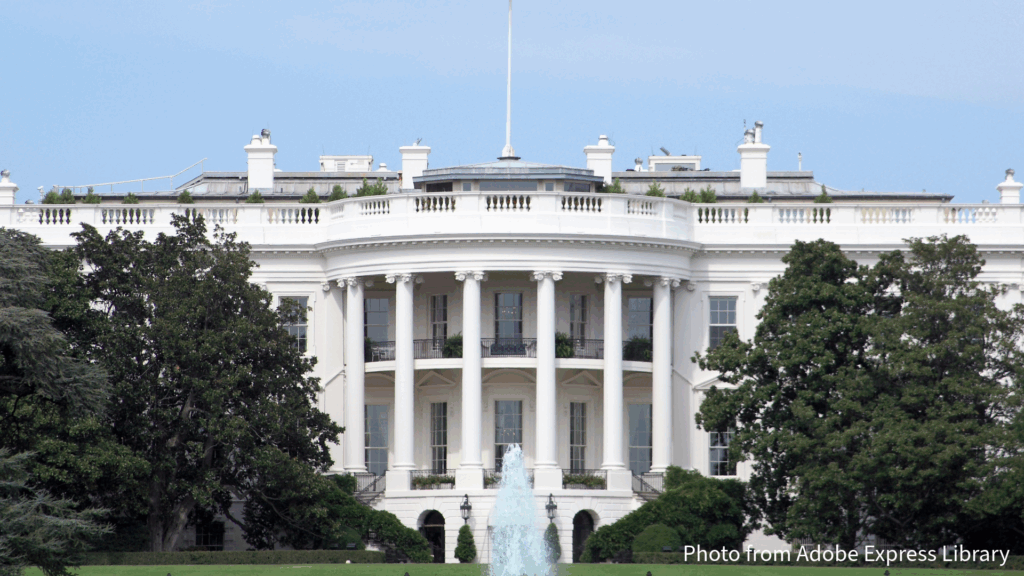
We talk a lot about “checks and balances” in America – but how many of us actually know the rules? Article II of the Constitution lays out the powers and responsibilities of the President of the United States, and it’s both more limited and more open-ended than you might expect.
So how did we get from George Washington refusing a third term to presidents of both parties issuing sweeping executive orders and waging war without Congressional declarations? If the Constitution is going to be more than just parchment and platitudes, we must’ understand the job description for the most powerful position in American government – and what we, as citizens, can do to hold it accountable. In this piece, we dig into Article II, how executive power has expanded over time, what the Constitution actually says, and what all of it means for civic power today.
Why were the framers of our Constitution willing to put so much power in the hands of one person after winning their independence from a monarch? Before we answer that question, let’s take a look at what Article II says. It starts out with some requirements for eligibility and term length and then details the process of electing a President through the electoral college. It even spells out the exact oath of office required upon inauguration. After that, Article II lays out the President’s powers (summarized as: commander in chief, foreign policy, appointments, pardons) and responsibilities – including an often-controversial requirement to “faithfully execute the laws”. Many of these clauses are quite vague and have broad interpretations, as discussed below, regarding the evolution of this branch.
Lastly, Article II provides the greatest check on the Executive (and other civil Officers): removal via impeachment and conviction for “Treason, Bribery, or other high Crimes and Misdemeanors.”
So let’s answer the question: “Why did our forefathers give the Executive so much power?” First, they gave the Legislative Branch more – Congress represents the People and the President’s primary duty is faithfully executing laws that Congress passes. Second, they gave Congress the ability to impeach, convict, and remove any President that substantially violates their oath of office, and the Judiciary Branch has the power to rule in opposition to executive actions. After enduring such tyranny themselves, they believed that no Congress would abdicate its responsibilities wholesale if a President significantly overreached. Third, it is important to remember that the Executive Branch began with only a few hundred staffers in 1789 – today the entire Executive Branch employs several million people, including staff and appointees. They were not omniscient and it would have been hard to imagine the amount of influence that a President could wield as the power of the federal government grew throughout history. In short, the framers likely did not intend for the Presidency to have the power it does today.
The Evolution of the Presidency
The Constitution intended the Executive only to enforce, not to legislate. They limited presidential term length – and later norms around two terms – so that the People would have the ability to replace their leader.
As most of us know from Hamilton, George Washington limited executive power by serving two terms and voluntarily stepping down, setting a lasting precedent for the peaceful and regular transfer of power. For much of the 1800s, the presidency remained relatively restrained, with a few notable exceptions that expanded executive authority and sparked significant debate at the time—such as Jefferson’s Louisiana Purchase and Lincoln’s wartime suspension of civil liberties.
Franklin Roosevelt massively expanded the federal government to respond to the Great Depression. He created federal agencies by executive action and made the federal government a fixture in modern economic life. The outbreak of World War II further centralized diplomacy and military leadership in the White House.
As the government grew through the New Deal (FDR) and the Great Society (Johnson), a new form of legislation quietly began taking shape via regulation. Environmental, labor, and financial rules began issuing from the White House, in many cases from departments and agencies that were created within the Executive Branch by acts of Congress. Even though the President is not allowed to make laws, “the Court has recognized that officials appointed by the President—even those located within the Executive Branch—may exercise regulatory or adjudicative powers that are quasi-legislative or quasi-judicial” (Constitution Annotated).
Executive Acts
The Constitution does not explicitly state what an executive order is, but it has become one of the most potent tools in the presidential tool chest since the federal government has a say in so many things in our lives. Executive orders are binding instructions to the federal government.
Franklin Roosevelt was by far the biggest user of executive actions. Since 1969, though, Presidents have averaged 269 executive orders per term, with no major outliers (by the numbers anyway). Donald Trump has already issued 161 over the first five months of his second term – and of note, at least 30 of them cite national emergencies to claim broader power over things like tariffs and environmental rollbacks.
The pure count of executive orders can be misleading, though. The scope of each order continues growing as each order seeks to take substantive action, demonstrating that Presidents are increasingly turning to executive orders to achieve policy goals, such as DACA, immigration, AI, pandemic response, and much more. One Biden order included over 40 distinct directives.
Other branches have important checks on executive orders. First, Congress can rescind orders or defund their implementation. More commonly, courts strike down executive orders that appear to exceed their legal authority. When Presidents do use executive orders to quasi-legislate, sometimes it has a lasting effect and other times it can be easily undone by their successor. Executive orders are most common during cases of political gridlock, but they also raise questions about legislative bypass and democratic oversight. Presidents have the power to administer the Executive Branch in many ways as they see fit, but Congress has the power of the purse, some executive departments and agencies were established by Congress, and the courts are able to rule against each executive departure. There is a growing judicial doctrine called the “major questions doctrine” that requires the Executive to seek statutory authority when they attempt large-scale executive actions.
Commander v. Congress
Perhaps nowhere is the tension between executive power growth and congressional decline more apparent than in military command. As we explored in our last piece on Article I, the War Powers Resolution of 1973 attempted to rein in executive overreach and dictate the terms by which military force is authorized, and for how long.
Congress unanimously passed the Authorization of the Use of Military Force (AUMF) in September 2001 for the so-called “War on Terror”, but since authorization was unlimited in scope, duration, and geography, (some call it a blank check), it has been exploited to invade Iraq and perform missions in Yemen, Somalia, Libya, Syria, and beyond. Even though, as Senator Rand Paul noted in 2023, the AUMF “never intended to authorize worldwide war, all the time, everywhere, forever,” numerous repeal and replacement attempts have failed. The Office of the President has held a broad, global military authority since Congress abdicated that important Constitutional responsibility almost 24 years ago.
Electoral College
Every four years, the President is selected by a popular vote within each state that commits electors to vote for him or her. The Electoral College is intended to balance population centers and rural areas, ensuring that pure democratic rule does not overpower the voices of citizens in rural areas. The Founders debated Presidential elections for months, with some delegates insisting that Congress should elect the President (opponents argued this could lead to corruption) while others believed a popular vote was the best option (opponents argued this could lead to democratic mob rule and excess executive power).
What results is a mixed bag of concerns from the Left and Right. Liberals rightfully point to the fact that Democratic Presidential candidates have won the popular vote in six of the last seven elections and still lost three of them. Conservatives argue that the Founders correctly foresaw that an executive could be elected based on population growth or urban migration alone, therefore this constitutional requirement sets a level playing field for all.
No matter who claims the White House every four years, they always celebrate the fact that voters have given them a “mandate” to pursue their agenda. All Presidents who win the popular vote claim this as a mandate, but in recent years, Presidents increasingly point to more specific analytics like swing state victories or inroads with key demographics. The opposition party inevitably attempts to undermine the legitimacy of each President’s self-proclaimed mandate by highlighting a different set of selective data points. Despite these attempts to increase their political capital and ride a powerful wave following their election, there is a growing body of scholarly evidence that these claims actually invite skepticism and signal greater weakness than strength.
Accountability and Impeachment
Presidents and other officials can be impeached if they are accused and convicted of “treason, Bribery, or other high Crimes and Misdemeanors.” Treason is explicitly defined in Article III (levying War against [the United States, or in adhering to their Enemies, giving them Aid and Comfort). Bribery was codified in 18 U.S.C. § 201 and includes much more detail. However, “high crimes and misdemeanors” remains intentionally broad and vague. Originally, the Founders had bribery and treason listed, but they wanted to account for extraordinary crimes, especially those that abused public trust or subverted the government or Constitution. Alexander Hamilton referred to high crimes and misdemeanors as “injuries done immediately to the society itself” in Federalist No. 65.
Even though centuries have passed since the Constitution was signed, the debates over these words and their applicability remains. Article I grants the House the power to impeach and the Senate the responsibility to try and convict. Only three Presidents have been impeached: Johnson, Clinton, and Trump (twice), although Nixon was also accused and resigned before the House completed its trial. Notably, none have been removed by the Senate. Public and political pressure eroded during the Clinton trial and Trump was defended by most Republicans. Presidential removal via conviction in the Senate is an intentionally high bar, requiring a two-thirds vote. Moreover, the political and constitutional fallout is largely untested, so it becomes a large political risk for any party attempting this action.
Norms, Checks, and Balances
The White House is full of pomp, circumstance, and a set of widely accepted behaviors. When actions fall outside these norms, there is inevitably the question around dinner tables across the country, “Can he do that?”
Here are a few presidential norms that have developed over time. These are ways politicians act in good faith with the American People, even though they are not officially required:
- Releasing tax returns
- Not firing Special Counsels or Attorneys General for political reasons.
- Avoiding overt politicization of the military or intelligence agencies.
- Peaceful transfer of power.
- Presidential term limits (a norm before the 22nd Amendment in 1951).
There are also some important semi-legal norms that are notably missing from the Constitution:
- “Executive privilege” developed as Presidents resisted subpoenas or oversight, citing the need for confidential advice. This is not in the Constitution but now considered a routine presidential defense.
- Legislative oversight hearings are not mentioned in Article I, but have become a powerful informal norm of Congressional authority.
So, do norms matter? Yes and no. While nothing requires the government to operate in some ways, the consistent role that the federal government plays in the background of our civic, social, and economic lives is critical to a sense of stability in our country. That foundational security can be threatened when Presidents operate outside established norms or take unexpected actions. Very few people believe Washington, D.C. works the way it should, so it is also important to note that sometimes norms evolve in healthy ways that benefit society. But not every norm is permanent.
Civic Power in a Polarized Age
This article ends the same way that The People’s Power ended: federal institutions derive legitimacy from the people – but only if the people engage.
We should expect a high degree of moral character from the people who represent us, especially the one that holds the moral authority of the country and the bully pulpit. Congress is the only federal body that is directly and regularly accountable to the People, so it is important to review and understand the checks and balances they can place on the Executive Branch, whether you support or oppose the actions of a presidential administration.
Even though Congress is the People’s Branch, that does not mean that you are powerless to communicate with the executive. Presidents, especially in this day and age, are acutely aware of and responsive to public opinion and polling numbers. Whether that comes in the form of (social) media mentions, protests or boycotts, petitions, supporting advocacy groups, and even filing Freedom of Information Act (FOIA) requests, your voice matters. Use it.
Please note: We at KYCfD are not lawyers or legal scholars — we are average citizens trying to lean on and reclaim the founding truths in our country in a tumultuous time. Please comment on our social media posts or send us a message if you find inaccuracies in our newsletter or want to provide additional insights. We will issue corrections and clarifications as often as we need to! We will continue to publish pieces that outline key elements of our Constitution in each newsletter, so be sure to follow KCfD on Facebook and at www.kycitizens.org!
Further reading:
Read the full Constitution and find in-depth analysis of each part, as well as critical cases and more: https://constitution.congress.gov/constitution/
You can purchase a pocket-sized Constitution numerous places, including Amazon for $1.50 here: https://www.amazon.com/gp/product/0880801441/
The National Constitution Center’s Interactive Constitution helps the entire document come alive, with historical and modern context and scholarly commentary on each section: https://constitutioncenter.org/interactive-constitution
Leave a Reply