Keeping it Constitutional – Special July 4th Edition
By: Eric Ruppel
This article is a special edition within a series exploring the U.S. Constitution and other founding documents, from their foundations and original debates to their application and evolution in modern society. To read our first piece about the purpose of government through the lens of the Preamble, check it out. To learn more about Congress, “the People’s branch”, click here. The Presidency is examined via Article II here. Stay tuned for pieces on the Judiciary, the Bill of Rights, and more.
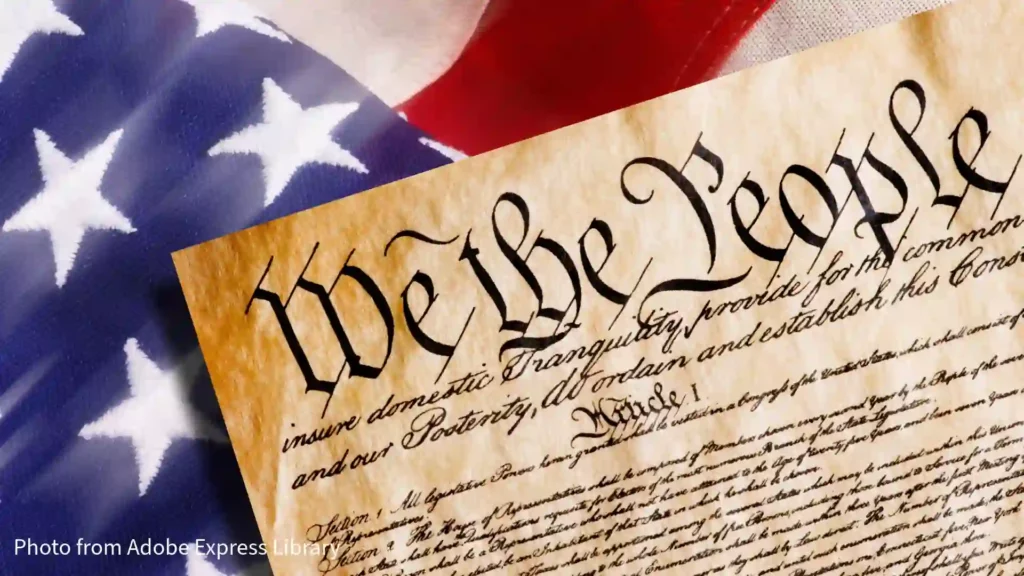
Why Revisit the Declaration of Independence?
Every July we set off fireworks in neighborhoods across America to celebrate our freedom, but between all the burgers and sparklers, it is easy to overlook the courage it took to declare independence from Britain, the values enshrined in our foundation, and how much this Declaration shaped our modern government. It is much more than just a dusty old historic document; it still has meaning for us in civic life and we should take another look at it.
First, The Declaration is broken into four parts: to begin, a Preamble introduces the philosophical principles of independence. Second, the Continental Congress wrote a summary of “natural rights” that includes the famous phrase, “all men are created equal, that they are endowed by their Creator with certain unalienable Rights, that among these are Life, Liberty and the pursuit of Happiness.” Once they established these rights, Thomas Jefferson and his team provided a list of twenty-seven grievances against King George, alleging that he had irreparably injured the people of the American colonies. The final paragraph then conclusively declares independence from the Crown.
There are no minced words here; these writers understood that in both broad and specific ways, this king had abused both them, and his power. The grievances listed in 1776 include legislative obstruction, judicial manipulation, military imposition, the violation of laws and political representation, economic exploitation, numerous warlike acts, and a failure to address multiple petitions – instead heaping on “repeated injury.”
The Role of Government – According to Jefferson
As we established in our piece about Article I, our federal government only has the powers granted to it by the people, through the Constitution. This idea was hinted at in the Declaration of Independence: “to secure these rights, Governments are instituted among Men, deriving their just powers from the consent of the governed.” In an era when kings believed they were given broad and exclusive power directly from God himself, this was a radical notion – and we still benefit from their foresight today.
We also recently covered the roles and goals of our federal government using the lens of the Preamble. As the lead author of the Declaration of Independence, Thomas Jefferson wrote that “when a long train of abuses and usurpations … evinces a design to reduce them under absolute Despotism, it is their right, it is their duty, to throw off such Government.” Simplified: if a government becomes tyrannical, citizens must reject it.
But the colonists did not go immediately from abuse to independence. The Declaration makes it clear that the pressure mounted over time as King George tightened the screws on his colonial subjects, and their American leaders lodged repeated complaints that went ignored. Independence came about slowly and methodically, the result of thousands of small acts over the course of years. Ultimately, this is why things like public peaceful protest, calling your legislators, and other civic actions are incredibly important. It is our responsibility to ensure that those in power hear our voices and concerns, especially when we want to make the case that change is needed.
A Civic Reading in 2025
It’s hard to overlook words sometimes, and perhaps the most glaring words from 1776 are “all men.” Those rights were not always universal, even among men, let alone extended to women. Now, almost 250 years later, we have seen decades come and go that freed the slaves, gave women and people of color the right to vote, and more – but we still have room to grow before we realize a future where all people are guaranteed equal rights to Life, Liberty, and the Pursuit of Happiness in all areas of life.
Among our fellow humans, there are still more grievances to understand today, some of which are older than the Declaration itself. Even though we don’t always need to respond to every single issue, platform, and social media post, it is nonetheless important that we keep wrestling with these truths. Not every grievance requires a revolution, but we should ultimately pursue resolution in keeping with what Lincoln called the “better angels of our nature.” As Americans, we do still hope to uphold these values for all people, and there are still many left hoping that tomorrow will bring them closer to that reality.
Civic Power in a Polarized Age
July 4th is more than a celebration. It is a recommitment to the ideals of justice, equality, and a government that is answerable to the Constitution that created it. It is an acknowledgment that our freedoms were hard-won by those who were willing to challenge a powerful king when he overstepped his authority. It is a rededication of the values of Life, Liberty, and the Pursuit of Happiness.
You citizens were not only born or naturalized into this legacy; you were endowed with this responsibility.
So maybe even try a little experiment this Fourth of July. If you can find 8 to 10 minutes of free time, as awkward as it may feel, read it out loud (or you can listen to a reading of it on our YouTube page). Pretend it’s a public speech and that King George is sitting in the audience. Imagine the weight of the moment as free, democratically-minded people considered what they would create if they were given the right to govern themselves and determine their own future. Imagine the weight of all that was still unclear and yet to be decided – from states’ rights to the practice of slavery to the three branches of federal power to taxation and central banks and beyond. Imagine again the weight of this gathering in July 1776, fully knowing their losses in battles over the prior year and the deadly struggle that would result from their signatures.
In the face of that great weight, they hoped. They hoped they would prevail on the battlefield. They hoped that following that, despite their substantial differences, they could confer, listen, and agree to bring about monumental and lasting change. They hoped they could establish an enduring freedom for themselves and for all who came after in times of peace. Imagine the fervent blend of both anxiety and hope that must have been present in the Philadelphia state house in the summer 1776.
Let’s all take a few minutes today and rededicate ourselves to the ideals that founded this country and recapture a little bit of that flame. Wherever you find yourself on July 4th, remember that these freedoms are for you, your neighbors, and all who come after us. If it feels like we are still a long way off, it means there is still work to do. Sign up for our newsletter and follow us on social media to get regular updates on how you can step up at this moment in history.
Please note: We at KYCfD are not lawyers or legal scholars — we are average citizens trying to lean on and reclaim the founding truths in our country in a tumultuous time. Please comment on our social media posts or send us a message if you find inaccuracies in our newsletter or want to provide additional insights. We will issue corrections and clarifications as often as we need to! We will continue to publish pieces that outline key elements of our Constitution in each newsletter, so be sure to follow KCfD on Facebook and at www.kycitizens.org!
Further reading:
The National Archives has a transcript of the Declaration of Independence available in full here: https://www.archives.gov/founding-docs/declaration-transcript
While you’re reading, go ahead and keep it constitutional – this site has an in-depth analysis of each part of the Constitution, as well as critical cases and more: https://constitution.congress.gov/constitution/ You can purchase a pocket-sized Constitution + Declaration in numerous places, including on Amazon (and beyond!) for $1.50 here: https://www.amazon.com/gp/product/0880801441/
Leave a Reply